Investment Strategy — 2026
Business owners can deduct up to $1.16 million in office art this year. Here is the complete guide to art investment tax benefits — and why direct ownership outperforms every fractional platform on the market.
In This Guide
• 01 Why Traditional Portfolios Need Alternative Assets
• 02 Art Market Performance: The Auction Data
• 03 Section 179: The $1.16M Business Art Deduction
• 04 De Minimis Safe Harbor & Immediate Expensing
• 05 Bonus Depreciation: Art as Tangible Personal Property
• 06 The Charitable Donation Strategy
• 07 Provocateur vs. Fractional Platforms
• 08 Frequently Asked Questions
Why Traditional Portfolios Need Alternative Assets
The 60/40 portfolio — 60% equities, 40% bonds — delivered exceptional risk-adjusted returns for four decades. Then came 2022, when both legs of the trade fell simultaneously for the first time since 1969. Stocks dropped 19%. Long-duration bonds dropped 27%. The diversification that was supposed to protect investors did not.
The structural problem is correlation. When interest rates rise sharply, both stocks and bonds reprice lower — they are no longer uncorrelated assets. What institutional investors have known for decades, but high-net-worth individuals are increasingly recognizing, is that genuine diversification requires assets that operate on entirely different return drivers. Real estate. Private credit. Commodities. And art.
Contemporary fine art has historically moved on its own schedule. The drivers of art market appreciation — artist career trajectory, institutional recognition, collector demand for specific works, edition scarcity — are largely insulated from interest rate cycles, earnings revisions, and the macro forces that move public markets simultaneously. This is the diversification that actually works: assets that do not care what the Fed did this week.
But art has a structural advantage that no other alternative asset class offers in the same form: it sits in your office. It is not locked in a warehouse, managed by a fund, or represented by a share of a Delaware LLC. It generates utility — aesthetic, cultural, conversational — while it appreciates. And for business owners, that physical presence in a commercial space is exactly what makes a range of significant tax strategies available.
This guide is for two types of readers. First: business owners who want to understand how acquiring art through their company can generate real, documented tax benefits while building a collection that holds and grows value. Second: serious collectors who are thinking about collection strategy at the $50K–$500K+ level and want to understand how to structure acquisitions for maximum long-term financial efficiency.
The strategies covered here — Section 179, de minimis safe harbor, bonus depreciation, and charitable giving — are well-established, used by sophisticated collectors and family offices, and entirely legal when executed correctly. None of this is a gray area. It is just knowledge that most art buyers do not have and most galleries do not share.
We share it because informed collectors make better long-term partners. And because the art that qualifies for these strategies — small-edition, investment-grade contemporary work with strong institutional trajectory — is exactly what Provocateur represents .
Art Market Performance: The Auction Data
Investment arguments for art work best when grounded in documented market performance. The contemporary art market produces verifiable auction records — prices that reflect real transactions between willing buyers and sellers, not estimated valuations. Here is what the data shows.
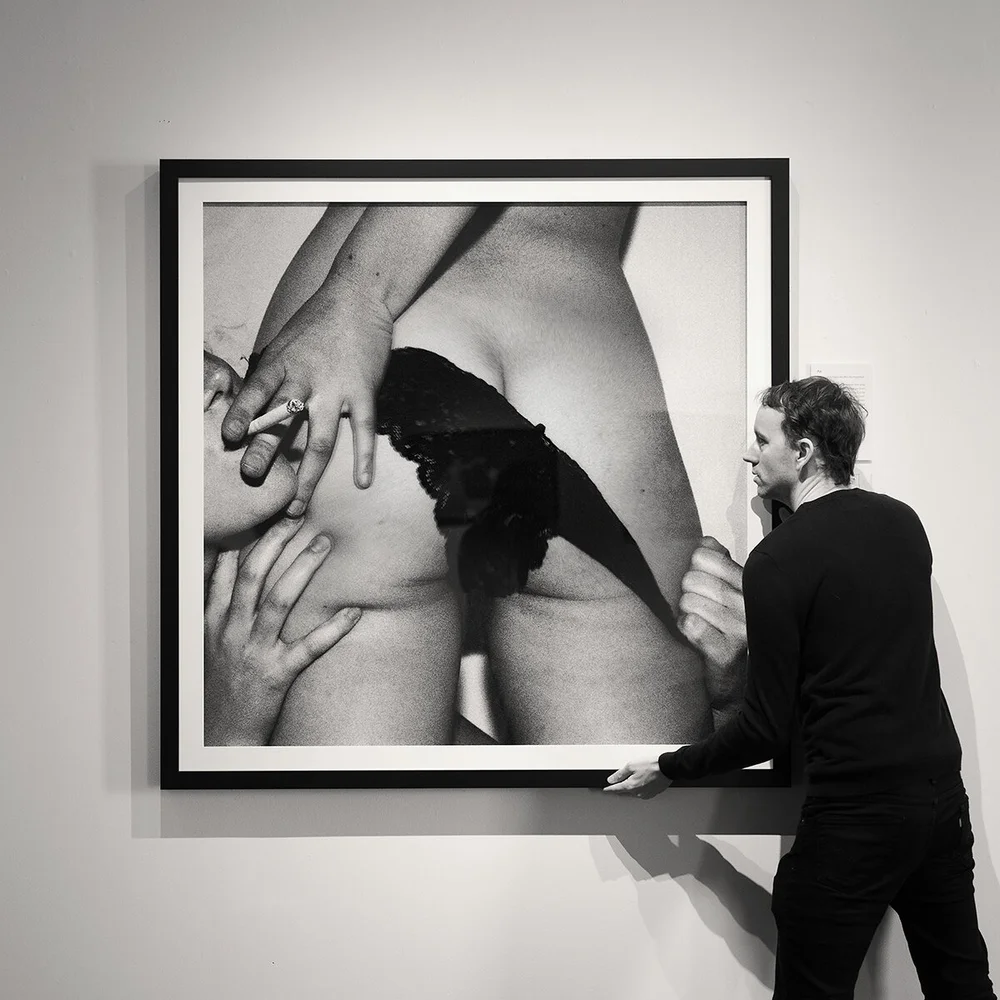
Investment-grade contemporary photography — small editions, documented provenance, secondary market performance data available through Provocateur Gallery.
Blue-Chip Benchmarks: Warhol, Banksy, Wesselmann
Andy Warhol remains the most liquid name in the post-war and contemporary art market. His screenprints and drawings have traded consistently at Christie's, Sotheby's, and Phillips for decades. Works acquired in the 1990s for $50,000–$200,000 have in many cases sold for $1–5 million at major auctions in the 2010s and 2020s. The key driver: institutional demand for a finite body of work from an artist whose cultural relevance has only grown since his death.
Banksy represents the opposite end of the spectrum — a living artist with a media-driven market. His screen prints, including the iconic "Girl with Balloon" series, have seen documented appreciation from original gallery issue prices of £500–£2,000 to secondary market sales of £200,000–£1,000,000+. The 2021 auction of "Love Is in the Bin" at Sotheby's London — the piece he shredded at auction in 2018 — sold for £18.6 million, demonstrating how narrative and cultural event create scarcity that amplifies appreciation.
Tom Wesselmann's work provides the clearest case study in edition scarcity driving value. His "Sunset Nude" series and metallic graphic works were available from galleries in the $10,000–$40,000 range in the early 2000s. By the mid-2010s, comparable works were trading at auction for $150,000–$400,000. The appreciation was not driven by macro conditions — it was driven by institutional acquisition, museum retrospectives, and the finite supply of works from a career that ended with his death in 2004.
The full auction data and ROI case studies for these artists and others are available on our Investment Research page .
What the Data Tells Collectors
The consistent pattern across all high-performing art investments is the same: a finite body of work, an artist with rising institutional recognition, and a collector base that has absorbed the majority of available supply. When these three conditions are met, secondary market prices respond to demand that cannot be met by new production.
This is why edition structure matters more than almost any other acquisition criterion. An open edition cannot appreciate. An edition of 500 will not generate scarcity-driven demand. An edition of 3–10 by an artist with museum exhibitions and growing institutional attention is the structure that produces the Wesselmann outcome — works that were available at gallery pricing that are now genuinely difficult to acquire.
For collectors building a portfolio strategy, the right question is not "which artists have already appreciated most?" — it is "which artists are currently at the inflection point where primary acquisition is still available, edition supply is tightening, and institutional trajectory is clearly upward?" That is the research that informs what Provocateur acquires and represents. See the full analysis at /investment .
Portfolio Correlation: Art vs. S&P 500
The correlation coefficient between the Artprice Global Index and the S&P 500 over the past two decades is approximately 0.3 — positive but weak. In practical terms, this means art tends to drift upward during equity bull markets but does not fall nearly as sharply during corrections. During the 2008–2009 financial crisis, the global art market contracted approximately 36% from its 2007 peak. The S&P 500 fell 57%. During the 2020 COVID dislocation, auction volumes temporarily contracted but prices for in-demand works held. Blue-chip art prices recovered within 12 months.
The asymmetry — art participates in upside but cushions downside — is exactly what portfolio construction theory demands from an alternative allocation. Combined with the tax strategies available to business owners, the effective cost basis for an art acquisition can be substantially reduced, improving the risk-adjusted return profile before any market appreciation is considered.
Section 179: The $1.16 Million Business Art Deduction
Section 179 of the Internal Revenue Code allows businesses to deduct the full purchase price of qualifying equipment and property — including, in the right circumstances, art displayed in business locations — in the year of purchase rather than depreciating it over time. In 2026, the deduction limit is $1.16 million.

Art displayed in active business locations may qualify for Section 179 immediate expensing — consult a qualified tax advisor for your specific situation.
How Section 179 Works for Art
The IRS historically classified art as a "collectible" and excluded it from standard equipment depreciation schedules. However, tax practitioners and courts have developed a more nuanced framework: art that meets the criteria of tangible personal property used in a trade or business — specifically, displayed in an active commercial space open to clients, customers, or employees — may qualify for Section 179 treatment.
The key distinctions are use and location. Art hung in a corporate office, law firm waiting room, medical practice lobby, hotel common area, or restaurant dining room serves a business function — it creates the environment in which commerce occurs. The IRS's "property used in a trade or business" standard has been applied to art in these contexts, though the analysis is fact-specific and depends on how the acquisition is documented and how the use is maintained.
• Active trade or business: The artwork must be used in connection with an active trade or business — not a passive investment, hobby, or personal residence
• Business location display: The work must be displayed at a commercial business location, not at your home (even if you work from home). Office, clinic, retail space, hospitality property, or client-facing commercial space
• Tangible personal property: The work must be a physical object — painting, photograph, sculpture. NFTs, digital works, and intangible assets do not qualify
• Placed in service during the tax year: The deduction is available in the year the work is installed and displayed at the business location, not when it is purchased
• Income limitation: Section 179 deductions cannot exceed the business's net taxable income for the year. Unused deductions carry forward but cannot create a net loss
• $1.16M annual limit (2026): The aggregate Section 179 deduction for all qualifying property placed in service during 2026 is capped at $1,160,000
Depreciation Schedules When Section 179 Does Not Apply
For art that does not meet Section 179 criteria — or where a business prefers to spread the deduction over time — art may be depreciable over its useful life under the Modified Accelerated Cost Recovery System (MACRS). The IRS has assigned a general 7-year class life to works that qualify as depreciable business property. This is longer than many business assets but still represents a meaningful deduction stream for significant acquisitions.
An important nuance: to depreciate art, the business must be able to demonstrate that the work has a determinable useful life — that it will exhaust, lose value, or become obsolete. Works by living artists are easier to place into a depreciation schedule; works by deceased artists with proven secondary markets present a more complex analysis because their value is more likely to have increased. This is one of the tax ironies of collecting: the art that appreciates most is often the most complex to depreciate, while the art that qualifies most cleanly for depreciation is the art you are most likely to want to sell at a gain.
Documentation Is Everything
The difference between a Section 179 deduction that withstands IRS scrutiny and one that does not is documentation. What is required:
Purchase documentation: Gallery invoice specifying the work (title, artist, medium, dimensions, edition number), purchase price, and business purpose. The invoice should reference the business entity, not the individual collector.
Placement records: Photographs of the work installed at the business location, dated and associated with the specific room or floor. Email records confirming installation are useful supporting documentation.
Certificate of authenticity: Authentication documentation for the work. This is standard for investment-grade gallery purchases — Provocateur provides complete documentation with every acquisition.
Qualified appraisal (for donations): If the work will eventually be donated, a qualified appraisal from a certified appraiser is required for deductions over $5,000. Starting this process at acquisition rather than at donation is best practice.
Note: Section 179 is a complex area of tax law and the treatment of art varies by facts and circumstances. This guide is for educational purposes only. Consult a qualified CPA or tax attorney before making acquisition or deduction decisions. Our tax strategy page provides additional context. For artist-specific examples of how these strategies apply to photography, see our guides for Tyler Shields and George Byrne — both produced in small editions that qualify when displayed in commercial spaces. For Park City collectors specifically, our overview of the investment art market in Park City covers how Utah's tax environment amplifies these strategies.
De Minimis Safe Harbor & Immediate Expensing
The de minimis safe harbor is the cleanest, most straightforward tax strategy available for business art acquisitions. Works priced at $2,500 or less per item can be immediately expensed in the year of purchase — no depreciation schedule, no complex analysis, no appraisal required.
How the De Minimis Safe Harbor Works
Under Treasury Regulation §1.263(a)-1(f), businesses without applicable financial statements (which covers the vast majority of small and mid-size businesses) may elect to expense tangible property costing $2,500 or less per invoice or per item. The election is made annually on the tax return and applies consistently to all qualifying purchases in the tax year.
For art collectors who operate businesses, this creates a straightforward strategy for building a collection of smaller works: acquire pieces at or below the threshold, display them in business locations, and expense them fully in the acquisition year. For a business owner in the 37% federal bracket plus state taxes, a $2,500 work effectively costs $1,500 after the tax benefit — and it is still on the wall, potentially appreciating.
• Threshold: $2,500 per item or per invoice for businesses without applicable financial statements. $5,000 per item for businesses with audited financial statements
• No depreciation schedule: Fully expensed in the year of purchase — no annual depreciation entries required
• Per-item, not per-collection: Each piece is evaluated independently. A set of five $2,000 prints purchased together on one invoice may be treated as five separate $2,000 items
• Annual election required: Must be elected on the tax return each year. Ask your CPA to include this election in your annual return
• Business use required: Same as Section 179 — the work must be used in an active trade or business, not in a personal residence
• No appraisal required: Unlike charitable donations, no qualified appraisal is needed for the de minimis election
Building a Collection Through the De Minimis Threshold
The practical application for collectors is to think about collection building in tiers. Works in the $500–$2,500 range — edition prints, works on paper, smaller photographs — can be acquired and immediately expensed with minimal administrative overhead. Works above the threshold require a more careful analysis (Section 179 or depreciation) but offer larger absolute deductions.
For business owners building a collection over time, a consistent annual program of acquiring 3–6 works at or below the de minimis threshold — combined with occasional larger acquisitions structured under Section 179 — creates both a growing collection and a systematic, defensible tax strategy. The key is consistency and documentation: purchasing for the business entity, displaying at business locations, and maintaining records of acquisition and placement.
Our available works include edition prints and photographs by represented artists at a range of price points, including works that fall within the de minimis safe harbor threshold. When pricing is relevant to your tax strategy, let us know during your consultation and we can structure acquisitions accordingly.
From Tax Benefits to Collection Building
The most elegant aspect of the de minimis strategy is that it transforms the tax efficiency of your acquisition into a real, physical collection that appreciates independently of the tax benefit. The after-tax cost is the floor; the future market value is the upside. A $2,500 work that costs you $1,500 after tax benefits and is worth $8,000 in ten years represents a return on actual out-of-pocket cost that no publicly traded alternative can consistently match.
This is why the combination of edition scarcity and tax strategy is so powerful: you are reducing your acquisition cost through documented, legal deductions while simultaneously acquiring works with the structural characteristics that drive secondary market appreciation. The two goals are not in conflict — they are complementary. See the Collecting Guide and our guide on starting a collection in Park City for the full framework on identifying works with strong appreciation characteristics.
Bonus Depreciation: Art as Tangible Personal Property
Bonus depreciation allows businesses to immediately deduct a percentage of the cost of qualifying tangible personal property in the year of purchase. For 2026, the bonus depreciation rate under current law is 40% (phasing down from 100% in 2022). Tax practitioners have advanced credible arguments that art qualifying as tangible personal property used in a trade or business may access these deductions.
The Practitioner Argument
The threshold question for bonus depreciation is whether art qualifies as "tangible personal property" under Section 168(k). The IRS's traditional position has been that art does not depreciate — it does not wear out, exhaust, or become obsolete. But this reasoning has been challenged in specific fact patterns: art used in high-traffic commercial environments (hotels, restaurants, medical offices) that sustains physical wear from proximity to patrons, temperature fluctuations, and handling does have a determinable physical life in those contexts.
More significantly, the Tax Cuts and Jobs Act of 2017 expanded bonus depreciation to include used property (not just new acquisitions) and broadened the definition of qualifying property. Tax practitioners have used this broader framework to advance bonus depreciation arguments for art in commercial use, particularly for acquisitions made through businesses with strong documentation of commercial use and placement.
• Commercial use environment: Hotel lobbies, restaurant dining rooms, medical waiting rooms, and retail spaces present the strongest argument for physical wear — environments where proximity to patrons creates genuine use-related deterioration risk
• Original use or expansion: Under current rules, works can qualify as "used property" if the taxpayer has not previously used them. Secondary market acquisitions displayed at a new business location may qualify
• Consistent treatment: If bonus depreciation is claimed on a work, it must be treated consistently — you cannot claim depreciation on the front end and then argue the work has not depreciated when it comes time to sell or donate
• Recapture risk: If the work appreciates and is sold, the depreciation previously claimed is recaptured as ordinary income (not capital gains). This can reduce the net benefit if the sale price significantly exceeds the acquisition cost
• Professional guidance essential: This is the most technically complex of the art tax strategies. Retain a CPA with art-specific experience before applying bonus depreciation to any collection
The Recapture Calculation
The interaction between bonus depreciation and a future appreciation-driven sale deserves careful attention. If you claim $50,000 in bonus depreciation on a work that later sells for $150,000, the $50,000 of previously claimed depreciation is recaptured as ordinary income in the year of sale — taxed at your ordinary income rate, not the favorable long-term capital gains rate. The remaining $100,000 of gain (after adjusting the cost basis for the claimed depreciation) is taxed as capital gains.
For works with strong appreciation trajectories, the recapture calculation often argues against aggressive early depreciation — you are trading ordinary income deductions now for ordinary income recapture later, while also reducing your cost basis and thus increasing the total capital gains amount. The donation strategy (Section 6 below) resolves this problem elegantly for the right works in the right circumstances.
2026 Bonus Depreciation Rate: 40%
Under current law, the bonus depreciation rate is phasing down: 100% in 2022, 80% in 2023, 60% in 2024, 40% in 2026, and 20% in 2027. Without new legislation, bonus depreciation will be eliminated after 2027. This creates a time-sensitive opportunity for business owners who want to maximize early deductions on qualifying art acquisitions — the 40% available in 2026 is significantly more favorable than what will be available in subsequent years absent legislative action.
For collectors who are also business owners with meaningful taxable income to shelter in 2026, this may be the most favorable year to make larger acquisitions structured for bonus depreciation treatment. Our art sourcing service can locate specific works by target artists on accelerated timelines for collectors with year-end tax planning objectives.
The Charitable Donation Strategy
Donating appreciated art to a qualified charitable organization generates a deduction equal to the fair market value of the work — not your original acquisition cost. For works that have significantly appreciated, this can be the single most tax-efficient transaction in a collector's financial life.
Works with documented appreciation history and full provenance are the ideal candidates for charitable donation strategy — the FMV deduction at time of gift, not the original acquisition cost.
How the FMV Deduction Works
When you donate a long-term capital gain asset (property held more than one year) to a qualified public charity, the tax rules allow a deduction equal to the fair market value of the property on the date of the gift — regardless of what you originally paid. This is the fundamental tax advantage of donating appreciated art versus selling it and donating cash.
Consider the math: You acquire a work for $15,000. Ten years later it is appraised at $60,000. If you sell it, you pay long-term capital gains tax on the $45,000 of appreciation — approximately $9,000 to $12,000 in federal tax depending on your bracket, leaving you with roughly $48,000–$51,000 to donate. If instead you donate the work directly, you deduct the full $60,000 FMV — receiving a tax benefit of $22,200 to $25,800 in a 37% ordinary income bracket — while having transferred the full $60,000 to the charitable institution. The tax efficiency of the direct donation is significantly superior in every scenario where the appreciation is substantial.
• Qualified organization: The donee must be a 501(c)(3) public charity or private foundation (with different deduction limits for private foundations). Museums, university collections, arts institutions, and certain conservation organizations qualify
• Related use: For the full FMV deduction, the charity must use the art for its exempt purpose (a museum displaying the work, for example). If the charity sells the donated work, your deduction is limited to your cost basis — not FMV
• Holding period: You must have held the work for more than one year for the FMV deduction to apply. Works held one year or less are limited to cost basis
• Qualified appraisal: For donations over $5,000, a qualified appraisal from a certified appraiser is required. The appraisal must be obtained within 60 days before the donation and no later than the tax return due date
• AGI limitation: Deductions for appreciated capital gain property are generally limited to 30% of adjusted gross income. Excess deductions carry forward for up to five years
• Form 8283: Required for noncash charitable contributions over $500. Galleries and auction houses routinely provide the documentation needed to complete this form
The Collector's Exit Strategy
For collectors who have built significant collections over decades, charitable donation is not just a tax strategy — it is a legacy and collection-management tool. Major collectors donate works to museums for multiple reasons: to ensure the works remain accessible to the public, to establish legacy and attribution, to reduce estate complexity, and to capture the tax efficiency of the FMV deduction. The financial and personal motivations align cleanly.
The most sophisticated approach is to plan the donation at the time of acquisition, not as an afterthought. Works acquired with strong institutional trajectory, clean provenance documentation, and appropriate edition structure are the works that will be accepted by serious museum collections — and those are exactly the works that will have appreciated most substantially by the time the donation is made.
Provocateur maintains relationships with museum and institutional curators and can advise on which works in our inventory are most likely to be accepted into significant collections, which is both a cultural judgment and a tax planning consideration. Contact us through the art sourcing page if charitable giving strategy is a priority in your collection planning.
Donor-Advised Funds and Art
Donor-Advised Funds (DAFs) accept donations of appreciated art in some circumstances, allowing the collector to take the FMV deduction in the year of contribution and recommend grants to specific charities over time. Not all DAFs accept art (the administrative burden of appraising and managing physical property is significant), but several major DAF sponsors including Fidelity Charitable, Schwab Charitable, and specialized art DAFs do accept physical artwork. This structure provides timing flexibility — the deduction is captured in the year of contribution to the DAF, while the actual museum placement can occur in subsequent years.
Provocateur vs. Fractional Art Platforms
Fractional art investment platforms have attracted significant retail investment by marketing contemporary art as an accessible asset class. The pitch is appealing: invest $500 in a Banksy, $2,000 in a Basquiat, diversify across 20 works. The reality, when examined closely, is significantly less favorable than direct gallery ownership.
The Fee Structure Problem
Masterworks, the most prominent fractional art investment platform, charges acquisition fees of 1.5–3% of the purchase price when they acquire a work. They charge annual management fees of 1.5% of the asset value every year you hold the investment. And when the work sells, they take a 20% profit commission on any appreciation above their acquisition cost — not above your investment cost.
Run the math on a 10-year hold. A $50,000 investment across their portfolio structure:
• Acquisition fee: $750–$1,500 (year 1)
• Annual management fees: $750/year × 10 years = $7,500
• Profit commission at exit: 20% of gross appreciation
If the underlying work appreciates 100% over 10 years (to $100,000), the platform takes $10,000 of the $50,000 gain as their profit commission. After management fees, your net return is approximately $32,000 on a $50,000 investment — a 64% return on a 10-year hold of an asset that doubled. Directly owning the same work and selling it yourself would produce the full $50,000 gain.
The Tax Strategy Disqualification
The most significant structural disadvantage of fractional ownership is that it disqualifies you from all of the tax strategies described in this guide. You do not own the artwork — you own a share of an LLC that owns the artwork. The artwork sits in a storage facility, not in your office. You cannot display it, donate it for a charitable deduction, or claim Section 179 on your share of an LLC's asset.
For a business owner in the 37% bracket, the difference between a $50,000 acquisition eligible for Section 179 (effective after-tax cost: approximately $31,500) and the same $50,000 in a fractional platform (full cost, plus ongoing fees) is $18,500 in year-one economics before any market appreciation. Fractional platforms work for investors without business income or tax planning objectives. For business owners with meaningful taxable income, direct ownership is structurally superior in every dimension that matters financially.
Transparent Pricing, No Commissions
Provocateur Gallery's pricing is straightforward: the price on the gallery invoice is the price you pay. No acquisition fees layered on top, no annual management fees, no profit commission when you sell. Our interest is in building long-term relationships with serious collectors — which means we make money when we help you acquire work you love and believe in, not when we extract fees from your appreciation over a decade.
We also offer a price-match guarantee : if you find the same work by the same artist at a lower price at another gallery, we will match it. We source work through direct artist relationships, which is the only way to guarantee primary market pricing — and the only way to ensure the small-edition, fully-documented acquisitions that investment-grade collecting requires. Explore current available works at /available-work .
Frequently Asked Questions
The most common questions from business owners and collectors researching art investment tax strategy.
Yes, in many cases. Section 179 allows businesses to immediately expense the cost of qualifying tangible personal property placed in service during the tax year, up to $1.16 million in 2026. Art displayed in an active business location — an office, conference room, lobby, or client-facing space — may qualify as depreciable tangible personal property. The key requirements are that the art must be used in an active trade or business, displayed at a business location (not a residence), and the business must have sufficient taxable income to absorb the deduction. Consult a qualified tax advisor to confirm qualification for your specific situation. Our tax strategy page provides additional detail.
The de minimis safe harbor allows businesses to immediately expense tangible property costing $2,500 or less per item (for businesses without applicable financial statements) in the year of purchase. For art collectors who are business owners, this means individual works priced at or below $2,500 can be fully expensed in the acquisition year with minimal documentation requirements. The per-item threshold applies per invoice or purchase, not per collection. This is one of the cleanest and most straightforward tax strategies for building an art collection through a business entity. Browse works within this threshold at our available works page .
When you donate appreciated art to a qualified charitable organization (typically a museum, university, or 501(c)(3) arts institution), you can generally deduct the fair market value of the work — not just your original cost basis. If you paid $15,000 for a work that has appreciated to $60,000, you can deduct $60,000. The deduction is typically limited to 30% of adjusted gross income for appreciated capital gain property donated to public charities, with a five-year carryforward for excess amounts. A qualified appraisal from a certified art appraiser is required for donations over $5,000. The related-use requirement applies: the charity must use the artwork for its exempt purpose to preserve the FMV deduction.
The core differences are ownership structure, fees, and tax eligibility. Fractional platforms charge acquisition fees, annual management fees of ~1.5%, and take a 20% profit commission on appreciation at exit. More significantly, fractional investors own a share of an LLC — not the actual artwork — which means they cannot display the work, claim Section 179 deductions, or execute charitable donation strategy. Provocateur offers direct, outright ownership with no management fees and no profit commissions. Full pricing transparency, a personal curator relationship, and eligibility for all applicable tax strategies. See the full comparison table in Section 7 above.
Yes. For tax purposes, fine art photography — including limited-edition prints by internationally exhibited photographers — is treated the same as paintings, drawings, and sculpture. Section 179, de minimis safe harbor, bonus depreciation arguments, and charitable donation FMV deductions all apply equally to photography as to other art media. What matters is how the work is used and displayed (for business deductions) and how it has appreciated (for donation strategy) — not the specific medium. Authentication, provenance documentation, and certificates of authenticity are equally important for photography as for other fine art forms. Provocateur provides complete documentation with every acquisition.
Next Step
Build a Collection That Works as Hard as You Do
The collectors who benefit most from art investment tax strategy are business owners who approach acquisitions with the same rigor they bring to every other capital allocation decision. We can help you identify works that meet your aesthetic standards, qualify for your tax objectives, and have the structural characteristics — edition scarcity, institutional trajectory, full documentation — that drive long-term appreciation. Schedule a consultation or explore current available works below.
Investment and tax disclaimer: This content is for educational and informational purposes only and does not constitute tax, legal, or investment advice. Tax laws change frequently and the application of tax strategies to art depends on specific facts and circumstances. Consult a qualified CPA, tax attorney, or financial advisor before making acquisition, deduction, or donation decisions. Past appreciation does not guarantee future returns. Art should be acquired primarily for its aesthetic and cultural value; financial returns and tax benefits are not guaranteed. Full investment disclaimer.
Related Posts
Stay in the conversation
Art market insights, new acquisitions, and investment strategies — delivered weekly.