Artist Profile — Tyler Shields
He directed for Disney, Showtime, and MTV before picking up a camera. What followed is one of the most distinctive bodies of work in contemporary photography — and one of the strongest acquisition cases in the Park City market right now.
In This Profile
• 01 From Hollywood to Fine Art
• 02 The Series: Provocateur, Indulgence, Chromatic, Suspense
• 03 Edition Structure & Technical Excellence
• 04 Market Trajectory & Collector Returns
• 05 Tyler Shields & Park City: A Natural Fit
• 06 Frequently Asked Questions
From Hollywood to Fine Art Photography
Most photographers find their way to the medium through traditional paths — art school, photojournalism, commercial work. Tyler Shields found his through the entertainment industry, and that origin shapes everything about how he makes images.
Shields spent the early part of his career directing for major entertainment properties: Disney Channel, Showtime, MTV. He directed music videos, short films, and narrative content for audiences that numbered in the millions. The vocabulary he absorbed — cinematic lighting, narrative tension, celebrity as currency — became the raw material for a body of photographic work that sits at the intersection of fine art and cultural commentary.
The transition from directing to photography was not a retreat from the entertainment world but a reorientation within it. Where a director serves a script and a studio, a photographer serves a vision. Shields took the technical sophistication of professional production — the crew, the lighting rigs, the post-production precision — and applied it to images that existed for their own sake, not as deliverables for a network or a brand.
The result is a practice that does not look like most contemporary photography. Shields' images are large-format, technically immaculate, and conceptually charged. They engage with celebrity, power, beauty, excess, and danger in ways that are immediately legible to audiences who have grown up inside the media cultures he spent his career making. The work is not difficult in the sense of requiring art historical fluency to appreciate — but it is not shallow either. The surface is seductive; the content beneath it is deliberate.
This combination — mass cultural accessibility married to conceptual seriousness — is precisely the profile that produces collector markets. Work that requires a PhD to appreciate has a limited buyer pool. Work that offers nothing beyond its visual surface has no secondary market. Shields' photography occupies the productive middle ground: instantly engaging, durable upon repeat viewing, and accumulating in cultural meaning as his career develops.
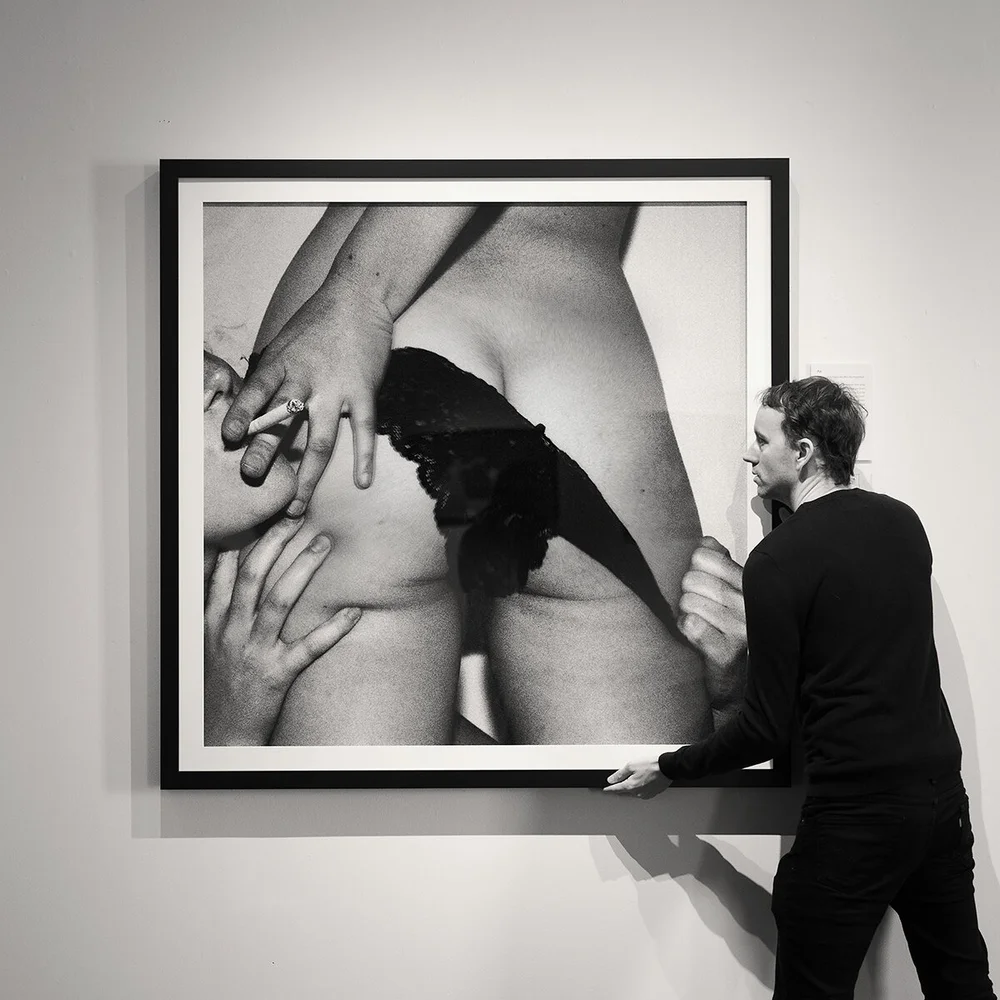
Tyler Shields brings Hollywood-level production craft to fine art photography. His images operate at a scale and technical quality that demands physical presence to fully appreciate.
His subject matter has consistently drawn from the Hollywood environment he came up in: celebrities photographed in scenarios that subvert or challenge the carefully managed images they normally project, luxury objects in contexts that question the values they represent, scenes that look like film stills from a movie about power and beauty and their discontents. The work has been covered by major publications — from fashion and entertainment media to serious photography criticism — which is a market signal in itself: sustained press attention from multiple demographics over an extended period indicates an artist whose market is not a flash in the pan.
Shields is now represented by galleries in multiple markets. His work is held by collectors in the United States, Europe, and Asia. His print runs sell out. And critically, for collectors in the Park City market, he is available through Provocateur Gallery at primary pricing — the original acquisition point before the secondary market takes over. Understanding why that matters requires understanding what he makes and how.
The Series: Provocateur, Indulgence, Chromatic, Suspense
Shields organizes his practice into distinct series, each with its own conceptual focus, visual language, and collector base. Understanding the series is essential for collectors — not because you need to specialize in one, but because different series attract different buyers at different price points, which shapes where the appreciation happens first.

The Indulgence series transforms luxury objects into vehicles for cultural commentary — a hallmark of Shields' ability to make images that operate simultaneously as beauty and critique.
Provocateur
The Provocateur series is Shields' foundational body of work — the series that established his reputation and defined his aesthetic. These images engage directly with celebrity culture, photographing recognizable figures in scenarios that challenge or subvert the public personas they project. The works in this series are some of his most extensively collected and most discussed in critical coverage.
The cultural logic of the Provocateur series is straightforward but not simple: celebrity is one of the defining phenomena of contemporary life, and most photography either reinforces the celebrity image (commercial portraiture, red carpet work) or demystifies it (paparazzi, documentary). Shields does neither. His celebrity subjects are complicit in the subversion — the photographs are made with the subjects, not of them — which produces a tension between the constructed image and the undoing of image-construction that is genuinely rare in contemporary photography.
For collectors, the Provocateur works carry the highest cultural recognition value — the most immediately legible to guests who see them on a wall, the most likely to be covered when the artist's career is written about, and historically among the first series to appreciate as an artist's market matures.
Indulgence
The Indulgence series shifts from celebrity subjects to luxury objects: watches, jewelry, shoes, handbags, firearms — the material vocabulary of wealth and status, rendered in conditions of excess or destruction. A $50,000 watch submerged in water. A couture gown on fire. The images simultaneously celebrate and interrogate the values they depict.
This is a series with a specific collector profile: buyers who move in the luxury goods world themselves — executives, entrepreneurs, people for whom the objects depicted are part of their daily experience — and who recognize in the images a visual intelligence about the culture those objects represent. The Indulgence series sells well to collectors who do not describe themselves primarily as art collectors, which is actually a sign of market health: a broader buyer pool sustains prices under pressure.
• Provocateur: Celebrity subjects, cultural power, image-construction — the foundational series and most extensively covered
• Indulgence: Luxury objects in extreme conditions — appeals to collectors from the luxury goods and finance world
• Chromatic: Color as structural element — technically demanding works that appeal to collectors focused on formal photography craft
• Suspense: Cinematic narrative stills — strongest resonance with entertainment industry collectors and Sundance-adjacent buyers
Chromatic
The Chromatic series represents Shields at his most formally rigorous. These are works in which color is not incidental but structural — the entire visual logic of the image is organized around chromatic relationships that amplify the emotional and conceptual content. The palette is deliberately pushed: supersaturated, sometimes almost overwhelming, always intentional.
Chromatic works attract collectors who come from a background in photography as a medium — buyers who understand the technical difficulty of producing color at this intensity without the image collapsing into graphic design, and who appreciate the precision required in both shooting and printing. These are often collectors with existing holdings in color photography who recognize in Shields' Chromatic work a serious engagement with the same formal problems that occupy the major color photographers of the last 50 years.
Suspense
The Suspense series is the most explicitly cinematic of Shields' bodies of work. These are images that look like film stills — not from any actual film, but from an imagined film that Shields is constructing one frame at a time. The visual grammar is borrowed directly from classic Hollywood: dramatic lighting, loaded gesture, narrative ambiguity, the frozen moment that implies everything that came before and after.
For collectors in the Park City market, the Suspense series has particular resonance. The Sundance Film Festival brings directors, producers, and industry professionals to this market every January — people whose professional vocabulary is exactly the visual grammar Shields is working with. A Suspense work on the wall of a Park City second home is not just an investment; it is a conversation piece for an audience that will immediately understand what it is doing. That kind of cultural specificity strengthens a market rather than narrowing it.
Edition Structure & Technical Excellence
The edition structure of a photographer's work is not incidental to its market value — it is one of the primary determinants of that value. Shields' approach to editions is deliberate and conservative, which has material consequences for collectors who understand what they are buying.
Why Edition Size Matters
The fundamental logic of the secondary market for photographic prints is scarcity. Unlike paintings, which are by definition unique, photographs are reproducible by nature — the edition structure is the mechanism by which a photographer introduces artificial scarcity into a medium that does not have it inherently. The smaller the edition, the fewer prints exist, the less supply is available when demand grows, and the more the price tends to rise.
Shields' standard edition structure — typically 3 prints plus 2 artist's proofs (3 + 2 AP) per image — is at the conservative end of the contemporary photography market. Compare this to photographers who produce editions of 10, 15, or 25: at those numbers, enough supply exists that the secondary market remains well-supplied for years after the primary edition sells out. At 3 + 2 AP, once the gallery's allocation is sold and the artist's proofs are held, the supply in any given market is extremely thin.
• Standard: 3 + 2 AP — among the most conservative structures in contemporary photography
• Once primary allocation is sold, only secondary market supply remains
• AP (Artist's Proof) works are retained by the artist and generally not for primary sale
• Works are individually numbered and signed — each comes with full documentation
• Certificates of authenticity are required to establish provenance for secondary market transactions
Shields' prints are produced to museum archival standards — chromogenic and dye transfer processes that ensure longevity and maintain value over the long term.
Chromogenic vs. Dye Transfer Prints
Shields produces his editions using two primary processes depending on the series, and the distinction matters for collectors focused on archival longevity and technical quality.
Chromogenic prints (also called C-prints or RA-4 prints) are the standard of professional color photography: light-sensitive paper exposed through an enlarger or digital exposer, then chemically processed to produce a continuous-tone color image. The best chromogenic papers — Fuji Crystal Archive, Kodak Endura — have archival ratings of 100+ years under appropriate storage conditions. Chromogenic prints have a luminosity and color depth that digital printing does not match, which is why serious photographers continue to use the process despite the labor and cost involved.
Dye transfer prints are rarer and more technically demanding — a process in which three separate color matrices are registered and transferred onto a receiving paper to produce a color image of extraordinary density and longevity. Dye transfer was the gold standard of color photography from the 1940s through the 1970s; its revival in fine art photography contexts is a deliberate signal of technical seriousness and archival ambition. Works produced via dye transfer command premiums in the secondary market both because of the process difficulty and because the resulting prints have archival ratings that far exceed any digital process.
For collectors, the practical implication is that Shields' prints will not fade, degrade, or become technically obsolete over the holding period that matters for serious collecting. The investment case for art includes the physical object — a work that deteriorates in quality over time does not hold value in the way a technically stable work does. Shields' production choices reflect an understanding of this that not every contemporary photographer shares.
Scale and Display
Shields produces his work at scales that require physical presence to fully appreciate. Most editions are available in multiple size options — from works suited to residential display (24×36 inches, 30×40 inches) to large-format works (40×60 inches, 48×72 inches) designed for commercial or institutional installation. The larger formats tend to command higher prices and, importantly, have a more limited buyer pool at primary — which concentrates the secondary market demand when those works surface.
For Park City collectors with large-format residential or commercial spaces — the open-plan interiors of high-end ski properties, corporate offices, hotel lobbies — the ability to acquire Shields' work at the scale it was designed for is a genuine advantage. Acquiring a 48×72 print from a represented gallery with full documentation is a different transaction than sourcing the same work from a secondary dealer, and not only in price.
Market Trajectory & Collector Returns
The art market does not move on a simple curve. It moves on the back of career events: major exhibitions, institutional acquisitions, critical reappraisals, auction appearances. Understanding where Tyler Shields sits on that curve — and what events are likely to shape the next chapter of it — is the analytical work that serious collectors do before acquiring.
Where the Market Is Now
Shields is in the phase of his career that historically precedes the most dramatic appreciation events for photography collectors: widely represented, internationally exhibited, with a documented collector base and consistent press coverage, but not yet at the stage where institutional acquisitions (museum purchases, major retrospectives) have fully catalyzed the secondary market. This is the window that, in retrospect, collectors who acquired early in artists' careers look back on as the moment they wish they had moved more aggressively.
His works at primary gallery pricing are priced to reflect the current state of his market — which is strong but not yet at the inflection point that institutional momentum creates. The collectors who acquired Banksy prints at £45–£400 in the early 2000s were not making speculative bets on an unknown quantity; they were making informed judgments about an artist whose trajectory was visible, whose work was culturally resonant, and whose edition structure meant that supply would not keep pace with demand as his market grew. The Shields situation rhymes.
Primary gallery pricing is the entry point before secondary market premiums apply. When an artist's market matures — when institutional acquisitions, auction results, and critical retrospectives align — the secondary market adjusts pricing to reflect scarcity rather than the original gallery list. Collectors who acquired at primary still hold the original cost basis; collectors who enter later pay the premium the secondary market assigns. The window to acquire Shields' work through a represented gallery at primary pricing is the present. Once print allocations sell out and the artist's institutional trajectory continues, the secondary market will reflect that — and the entry point will not look like it does today.
Auction History and Secondary Market Signals
Shields' works have appeared at auction and through secondary dealers in multiple markets, which establishes a pricing floor independent of gallery pricing — a critical data point for collectors who want to understand liquidity. When a collector can point to secondary market transaction history, the conversation about an artwork's value shifts from "what does the gallery say it's worth" to "what have buyers in an open market paid for comparable works by this artist." That distinction matters for serious collectors and their advisors.
The secondary market data for Shields' most collected series — particularly Provocateur and Indulgence works — shows consistent demand from buyers who did not acquire through primary channels. This is the natural next step in an artist's market development: the secondary market activates when primary supply tightens, which creates price discovery that validates and often exceeds the original gallery pricing. For collectors watching this market, the secondary activity is a confirmation of the thesis, not just a data point.
Risk Factors and the Disciplined View
No investment case is complete without an honest accounting of the risks. For Shields specifically: his market is still developing, which means it can develop in directions that are not fully predictable. The art market is illiquid — there is no exchange, no price feed, no guaranteed buyer when you want to sell. Appreciation that has occurred in some works does not guarantee appreciation in others, or continued appreciation in the same works. And photography as a medium faces a structural challenge that painting does not: the existence of digital reproduction means that the value of the physical print is always partly an argument about the difference between a physical object and a digital file — an argument that the culture continues to renegotiate.
The disciplined view accounts for these risks and still reaches the conclusion that Shields' work at primary pricing, held for an appropriate period, represents a compelling risk-adjusted acquisition opportunity for collectors who understand the market. But "understanding the market" includes understanding the downside — which is why we recommend reading the full Investment Research framework , the Collecting Guide , and our in-depth investment analysis of his photography market before making any acquisition decision based primarily on investment thesis.
The better acquisition motivation — and the one that has historically produced better outcomes — is acquiring work you genuinely want to live with from an artist you genuinely believe in. The investment thesis is most powerful when it is secondary to conviction. That conviction, for collectors who encounter Shields' work in person, tends to come from the work itself: it is large, technically overwhelming, and deeply engaged with the cultural moment it inhabits. Investors who become that are usually glad they were.
Tyler Shields & Park City: A Natural Fit
Every artist has a natural collector context — the demographic, cultural, and geographic environment where their work resonates most immediately and where the collector base most reliably forms. For Tyler Shields, Park City is not an arbitrary market. It is, in several meaningful ways, a perfect one.
The Sundance Collector
The Sundance Film Festival is the defining cultural event in the Park City calendar — a 10-day concentration of the global entertainment industry that brings directors, producers, distributors, talent agents, brand executives, and independent filmmakers to this market every January. These are people whose professional world is the world Tyler Shields came from and continues to engage with. His Suspense series speaks directly to the visual vocabulary of cinema. His Provocateur series engages with celebrity culture from the inside. The cultural literacy required to fully appreciate what Shields is doing is not general cultural literacy — it is specifically entertainment industry cultural literacy, and the Sundance audience has it in abundance.
For galleries with strong Shields inventory, Sundance is an annual activation event: the collector base walks through the door already primed to understand and respond to the work in a way that does not require explanation. The conversation starts further along than it does in most gallery contexts, and it ends more often at the acquisition conversation rather than the appreciation conversation.
The Second-Home Collector
Park City's second-home market is dominated by buyers from Los Angeles and San Francisco — markets where Shields' work is already well-known and well-collected. A Park City buyer with a primary residence in Bel-Air or Pacific Heights is not encountering Shields for the first time when they walk into Provocateur Gallery; they are encountering an opportunity to acquire work by an artist they have already contextualized, at a primary gallery price rather than the secondary premium they might pay in their home market.
This is a genuine advantage for the Park City gallery: the collector's homework is already done. They know who Tyler Shields is, they understand his market, and the conversation in a Park City gallery context can be about specific works and specific acquisition decisions rather than about introducing the artist. That efficiency in the collector relationship is one reason why galleries with direct artist representation in secondary markets — markets beyond the primary art market cities — tend to build strong collector relationships with second-home buyers.
The Park City Gallery Stroll
The monthly Gallery Stroll builds a consistent, engaged collector community that encounters new work from Provocateur Gallery's Shields inventory multiple times per year. For an artist with multiple series and ongoing production, this sustained exposure matters: a collector who sees a Chromatic work in October, reflects on it over the winter, and returns in March to find a Suspense work has been added is experiencing the collection's depth in a way that a single gallery visit does not allow. The Stroll creates a rhythm of collector engagement that, over time, produces acquisitions that a single-visit model would not.
Shields' series structure supports this dynamic particularly well. Because his work falls into distinct conceptual territories — each with its own visual language and collector resonance — a collector who has acquired from one series has a natural next conversation about another. The collection has an internal logic that invites continued engagement, which is exactly the collector relationship that produces both the best outcomes for collectors and the strongest gallery markets.
Provenance and Representation
Acquiring directly from a gallery that represents Tyler Shields provides something that secondary market acquisition does not: a direct provenance chain from artist to gallery to collector, documented at every stage. For works that will eventually be consigned or sold, this provenance is material to the transaction — a buyer in a secondary market context will pay more, and will transact more confidently, with a work whose ownership history begins at the gallery that represents the artist.
For Park City collectors who may eventually rotate works out of a collection — or who are building collections with a generational transfer in mind — the provenance that comes with primary gallery acquisition is not a luxury. It is the foundation of the work's future market value. See the Collecting Guide for more on provenance documentation and its role in collection management, our Consignment program for the structured exit path, and our art investment tax strategy guide if you are a business owner considering the Section 179 angle.
The combination of Sundance alignment, second-home collector familiarity, Gallery Stroll engagement, and primary provenance makes Park City — and specifically Provocateur Gallery — the right point of entry for collectors who want to acquire Tyler Shields' work at the moment in his career that will, in retrospect, look like the right time.
Frequently Asked Questions
The questions we hear most from collectors considering their first Tyler Shields acquisition.
Tyler Shields prints and editions are available through Provocateur Gallery, which maintains a direct representation relationship with the artist. Primary gallery pricing is the entry point before secondary market appreciation; acquiring directly through a represented gallery provides full provenance documentation, certificates of authenticity, and price-match guarantees against other retail gallery pricing on the same works. Visit our Tyler Shields artist page or contact us through the inquiry form to discuss current availability.
Tyler Shields' photography has the structural markers of an investable market: direct gallery representation, small editions (typically 3 + 2 AP), a documented international collector base, and an institutional trajectory that includes major publications and gallery shows across multiple markets. His works available at primary gallery pricing represent the acquisition window before secondary market demand drives prices above list. As with any artist investment, returns are not guaranteed — but the underlying market indicators support the thesis. See our Investment Research page for the full framework, and our Investment Art in Park City guide for the broader collecting context.
Tyler Shields works across several distinct series: Provocateur (his foundational celebrity and cultural power series), Indulgence (luxury objects transformed into commentary on excess), Chromatic (color-saturated works exploring the tension between beauty and violence), and Suspense (narrative scenes that borrow the visual grammar of classic Hollywood cinema). Each series has a distinct collector base and edition structure. The full series catalog is available on the Tyler Shields artist page at Provocateur Gallery.
Tyler Shields editions are deliberately small — typically 3 prints plus 2 artist's proofs (3 + 2 AP) per image. Works are produced as chromogenic prints or dye transfer prints depending on the series. The small edition structure means that once a gallery's primary allocation is sold, secondary market supply is very limited — which has historically been a precondition for secondary market price appreciation. Specific edition details, sizes, and availability are listed on each work's detail page at Provocateur Gallery.
Park City has a unique collector profile: Sundance Film Festival regulars, entertainment industry second-home owners, and sophisticated buyers relocating from coastal markets. Tyler Shields' work — rooted in Hollywood imagery, celebrity culture, and cinematic narrative — resonates particularly with this demographic. His background in film and television creates a shared cultural vocabulary with collectors who move in those same worlds. The combination of aesthetic alignment, primary gallery access through Provocateur Gallery, and investment-grade edition structure makes his work a natural fit for the Park City collecting environment. Read more about the Park City fit above.
Next Step
View Tyler Shields Works Now Available
Provocateur Gallery maintains primary representation of Tyler Shields, with current inventory spanning the Provocateur, Indulgence, Chromatic, and Suspense series. All works come with full provenance documentation, certificates of authenticity, and price-match guarantees against other retail gallery pricing. If you are in Park City — or planning to visit — we can arrange a private viewing appointment.
Investment disclaimer: Past appreciation does not guarantee future returns. Art should be acquired primarily for its aesthetic and cultural value; financial returns are not guaranteed. This content is for informational purposes only and does not constitute tax or investment advice. Consult qualified professionals before making acquisition or tax decisions. Full investment disclaimer.
Related Posts
Stay in the conversation
Art market insights, new acquisitions, and investment strategies — delivered weekly.